Friday, February 3, 2012

Google Beefs Up Security on Its Android Market


Google Inc. said it has beefed up security on its Android mobile-device software to better prevent "malicious" software from residing in its app store.
Hiroshi Lockheimer, Android's vice president of engineering, said in a post Thursday on the company's blog that Google last year began automatically scanning Android Market apps for malicious software, including "spyware" and "trojans."
The comments follow pronouncements by companies such as Juniper Networks Inc. and Lookout Inc.—both of which sell online-security services—that claimed last year that a growing number of malicious apps were appearing on the Android Market, where hundreds of thousands of apps are available for download. Google's comments also come after several instances where Google said it removed malicious apps from the Android Market after they had been downloaded to thousands of devices.
As a result of the latest security program, code-named "Bouncer," Google said the number of downloads of potentially malicious apps dropped 40% between the first and second half of 2011, though it didn't provide specific figures.
Malware could include apps that steal personal information about a smartphone user, including recordings of phone conversations or bank account passwords, among other things.
"While it's not possible to prevent bad people from building malware, the most important measurement is whether those bad applications are being installed from Android Market—and we know the rate is declining significantly," Mr. Lockheimer wrote on the blog.
Alex Stamos, co-founder of online-security firm iSEC Partners Inc., said the "number of people affected by mobile malware at this point has been minimal, but the public association between Android and a handful of outbreaks will be difficult to break if things get much worse."
Unlike Apple Inc.'s iOS, which powers the iPhone, or BlackBerry maker Research In Motion Ltd., Google doesn't have employees dedicated to approving apps submitted to its store. Google has said it had measures in place to detect and remove malicious apps.
Mr. Stamos said Apple's app store is "almost totally free of malware." He added that if Google's security enhancements lead to a significant decline in malware on Android, it will boost Google's philosophy of maintaining an "open" app market where anyone can easily offer apps to the public.
Dan Wallach, a Rice University professor who has pointed out security flaws in Android, said that malware isn't the biggest problem on mobile operating systems like Android. For example, he said, many people download legitimate apps that ask for permission to access much of the data on their device and then could sell that data to third parties such as advertisers.
Many people simply don't pay attention to such permission requests, he said. "The core issue is understanding that when you install an app, there's a risk," he said.
A Wall Street Journal investigation last year showed that dozens of popular smartphone apps on both Android and iPhone devices transmitted the phone's unique device ID and personal details about the phone's owner to other companies without users' awareness or consent.
Google's Mr. Lockheimer said Android's current system works well because people can read customer reviews of apps before deciding whether to download them, and many reviews discuss the privacy permissions sought by the app.
As of the fourth quarter of 2011, about 47% of smartphone subscribers used an Android phone, while nearly 30% used an Apple device, according to research firm comScore Inc.

Windows Phone 8 Details Gush Across Web


Windows Phone sculptureA pair of reports unleashed a tidal wave of information about Windows Phone 8 on Thursday afternoon, describing everything from hardware improvements to a wallet experience, plus an Opera Mini-like proxy to a tight integration with Windows 8.
PocketNow revealed the initial details. The site said that it had obtained a video starring Microsoft mobile phone guru Joe Belfiore, apparently intended for Nokia executives. Windows watcher and blogger Paul Thurott then chimed in with his own report conforming many of the same details, and referencing a recent post by Microsoft executives on how Windows 8 will interact with mobile broadband.
Microsoft declined to comment.
The relationship between Windows 8 and Windows Phone 8 (codename: Apollo) goes beyond just the name, according to PocketNow; apps designed for Windows 8 should run on Windows Phone 8 with a minimum of tweaking, and vice versa. PocketNow wasn't sure if the new release would maintain backwards app compatibility; Thurott claimed it would. All current Windows Phones run Windows Phone 7.5 "Mango," pictured.
"Windows Phone 8 is part of the "Windows Reimagined" campaign that Microsoft announced for Windows 8. This makes sense as they're companion products in every sense of the word," Thurrott claimed.
Windows Phone, although well-received by analysts, simply hasn't succeeded in the marketplace. Recent surveys in the United States by comScore show its market share steadily declining. Some have wondered whether Windows Phone can survive the long haul. But integration with the world's largest PC platform is something other mobile OSes can't provide.
One area in which Microsoft is apparently beefing up its capabilities are the phones' hardware specifications. Quad-core phones will be supported with displays with multiple resolutions, PocketNow said.
PocketNow claimed that data would be synced across the PC, the phone, and the Xbox via a new app; data will be backed up on SkyDrive, Thurrott added. The Zune app will be scrapped, in favor of a new connector app, while the Xbox Companion app will gain a complementary addition on Windows 8.
PocketNow also claimed that Microsoft will incorporate a proxy mechanism inside Windows Mobile 8, working in conjunction with Internet Explorer 10 Mobile. Thurrott called this technology "Data Smart," and pointed to the recent blog post, which notes how Microsoft will simplify connecting to mobile networks, and monitor data usage once connected.
"Prior to Windows 8, we maintained consistent behavior on all types of networks relative to bandwidth usage," program manager Billy Anders wrote. "With Windows 8, we now take the cost of the network into consideration: we assume that mobile broadband networks have restrictive data caps with higher overage costs (vs. Wi-Fi), and adjust networking behavior with these metered networks accordingly."
The camera app will be a platform of sorts, able to support third-party viewfinders and "lens apps". And there will be support for a Wallet application plus near-field-technology.
Skype won't be integrated, both Thurrott and PocketNow wrote.
Finally, there will be full-device, hardware accelerated encryption with BitLocker, Thurrott added.

Source: http://www.pcmag.com/article2/0,2817,2399788,00.asp 

Facebook IPO Turns L.A. Street Artist David Choe Into A Multi-Millionaire


When Los Angeles-based street artist David Choe took a stock offer over money years ago, it's likely he didn't expect it to pay out like this.

The 35-year-old Korean-American has achieved success in the world of art over the years, selling his work for thousands of dollars, being featured in gallery shows and exhibited in major museums. But, he's set to receive his biggest payday ever.

Choe was commissioned by Facebook to paint their first office in Palo Alto, California back in 2005 by then-president Sean Parker ... way before the social network became so integrated into the world we live in today.

Instead of getting paid, he gambled and took an equal value of shares of Facebook's stock. That decision has made him a very rich man.

Now the social network, in one of the world's most widely anticipated IPOs or initial public offerings of stock, has filed papers Wednesday (February 1) to raise at least $5 billion. That means Choe's shares could be worth upward of $200 million when Facebook stock trades publicly later this year, according to the New York Times.

The paper says that Choe said he thought, at the time, that the idea of Facebook was "ridiculous and pointless". Wow... he's probably glad he didn't think it was too ridiculous to do the job.

Facebook has more than 800 million active users today; and in 2011, eared profits of $1 billion on sales of $3.7 billion.

The Times calculated that Chose  -- based on the word of a former Facebook employee who said "advisers" to the company at that time, such as Choe -- would have received about 0.1 to 0.25 percent of the company. Based on a market value of $100 billion, his stake would be worth hundreds of millions of dollars.

Now, that's a big payout. Congrats to David Choe!

Thursday, February 2, 2012

Yahoo Releases Search Engine Dedicated to iPhone and Android Apps


The large array of apps available within both the iOS and Android environments is without a doubt good news for users, but at the same time it can be quite confusing to try to find the exact service or feature required.

A solution for this situation comes from an unexpected source. Yahoo has announced the launch of a new search engine capable of sorting through the 350,000 apps available in Apple's App Store and 200,000 apps from the Android Market.
The Yahoo App Search helps users get app descriptions, price details, ratings and even displays a screenshot for each app. The search engine comes with filtering options by platform, price or genre.

If this is not enough, the new Yahoo search engine features separate tabs to help users find Top Trending, Top Free, Top Paid and Most Reviewed apps. In order to help  the service improve, the users are encouraged to rate the apps and give feedback.

James Gammon, Yahoo search product marketing manager, loyal to his company and confident in its capabilities explained "only Yahoo App Search has both the search technology and is device agnostic so can offer users a choice of both Android and iPhone."


Read more: http://www.itproportal.com/2012/02/02/yahoo-releases-search-engine-dedicated-iphone-android-apps/#ixzz1lE5NCPtw

Facebook’s S-1 Reveals: 845 Million Users Every Month, More Than Half Daily, Half Mobile


As part of its initial filing to go public, Facebook has just revealed some new user numbers that illustrate just how big it is.
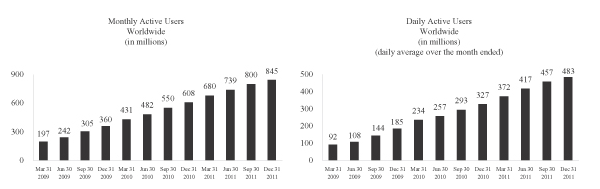
It had 845 million monthly active users and 483 million daily active users as of December, for year over year growth of 39% and 48% respectively. Mobile is also now half the user base, with 425 million monthly actives. Some other stats, which are a bit more vague: 100 billion friend connections as of the end of last year, and 2.7 billion Likes and Comments per day during the last three months of the year.
All in all, this basically stacks up with what the company has previously shared. It said in September that it had some 800 million MAUs.
One other point on the numbers is that Facebook is providing a fairly extensive caveat around what it’s counting:
The numbers of monthly active users (MAUs) and daily active users (DAUs) presented in this prospectus are based on internal company data and we use these numbers in managing our business. We believe that our MAU and DAU numbers are reasonable estimates, and we take measures to improve their accuracy, such as eliminating known fictitious or duplicate accounts. There are inherent challenges in measuring usage across large online and mobile populations around the world. For example, there may be individuals who have multiple Facebook accounts in violation of our terms of service, despite our efforts to detect and suppress such behavior. As another example, applications on certain mobile devices may automatically contact our servers for regular updates with no user action involved, and this activity may cause our system to count the user associated with such a device as an active user of Facebook. We estimate that less than 5% of our estimate of worldwide DAUs as of December 31, 2011 could have resulted from this type of automatic mobile activity and that this type of activity had an even smaller effect on our estimate of worldwide MAUs. The impact of this automatic activity on our metrics may vary by geography, as mobile usage varies in different regions of the world. In addition, our data regarding the geographic location of our users is based on a number of factors, such as IP address, which may not always accurately reflect user location. We regularly review and may adjust our processes for calculating these metrics to improve their accuracy. In addition, our MAU and DAU estimates will differ from estimates published by third parties due to differences in methodology. For example, some third parties do not count mobile users.

In filing, Facebook outlines its vulnerabilities


Facebook's IPO filing lays out the scenarios that could drive its success into a wall.


If you had 800 million friends, you'd think you'd be worry-free. But Facebook isn't.
As part of its plans to go public, the popular social network has spelled out its worst nightmares — a litany of scenarios in which its unmatched success in social networking is gnawed at by federal regulators, adverse media coverage, widespread privacy concerns, rampant hacker attacks, unseen flaws in its technology and, worst of all, unhappy users.
"It just struck me about how aware they are of their vulnerabilities," Ryan Calo, director of privacy at Stanford Law School's Center for Internet & Society, said after reading the 150-page document Facebook Inc. filed with federal regulators Wednesday to start its path toward an initial public offering of stock.
Many of Facebook's most serious concerns arise from a tension at the core of its business: ensuring the privacy of its customers while also using what it knows about them to court advertisers.
"They have a narrow path to walk, and their risk factors really dramatize that in a way we hadn't seen before," Calo said.
By storing, transmitting and analyzing the huge amount of user data it collects each day, Facebook said, it sends its customers "billions" of ads a day, all keyed to "the information they have chosen to share."
One of the company's triumphs as both a business and a popular digital gathering place is that it has coaxed users into sharing ever larger amounts of information about themselves and their daily doings — information it readily turns into advertising gold.
"The ad economy is really monetized by the sharing of personal information," said Ashkan Soltani, an independent privacy and security researcher.
"The more information that's flowing, the better the odds of targeting you are," Soltani said.
But the company has repeatedly run afoul of both its users and federal authorities who saw it as less than upfront about the kinds of information it collects and where it all ends up.
In November, the Federal Trade Commission accused the company of deception and violations of federal law by telling users it would keep their information private "and then repeatedly allowing it to be shared and made public."
As part of a far-reaching settlement, Facebook agreed to allow independent privacy audits every other year for 20 years and to obtain users' permission before changing privacy settings.
Noting the FTC probe and a similar bout recently with privacy regulators in Ireland, Facebook said in its filing with the Securities and Exchange Commission that it might well be subject to future investigations by government authorities.
That "could cause us to incur substantial costs or require us to change our business practices in a manner materially adverse to our business," the filing says.
Moreover, the company said that even though it takes substantial precautions to protect its rich cache of user data, hacking has become an increasing problem for Internet companies, and Facebook believes it may be in attackers' cross-hairs.
"Because of our prominence, we believe that we are a particularly attractive target for such attacks," it said. Any failure to protect its user data from malicious intrusions, the company acknowledged, "may harm our reputation and our ability to retain existing users and attract new users."
Though the FTC settlement led Chief Executive Mark Zuckerberg to declare he was "the first to admit that we've made a bunch of mistakes," he said he was "committed to making Facebook the leader in transparency and control around privacy."
Still, the company has already raised eyebrows among privacy critics with a data-sharing feature it unveiled last month.
The feature allowed popular Internet companies to launch several dozen new Facebook applications that — after they are first installed — automatically record and publicize a user's online activities, including the songs they listen to, the news stories they read and the videos they watch.
Facebook calls this "frictionless sharing" because users can be broadcasting their online doings without taking any action — or, as critics said, without even being aware they're doing it.

Google TV update will bring Chrome improvements, Blu-ray 3D support


If you happen to be in the slim minority of people who owns a Google TV-equipped Sony device, there’s an update heading your way this week. The new version of Google’s operating system for the big screen will make the TV-optimized version of Chrome run a bit speedier. It also adds support for Blu-ray 3D movies.
The search giant confirmed that the update is in the works through the official Google TV Twitter account. The company promised to roll out the new firmware “this week.” Of course, this update only applies to the Sony Internet TV line from around a year ago, and the 3D aspect applies to the small numer of Sony Blu-ray players with Google TV functionality. It does not include the Logitech Revue which was discontinued due to sluggish sales.
Google TV is hoping for a major comeback in 2012, with much-needed support finally confirmed from other high-end television manufacturers. But the question remains whether or not consumers see any value in having what is essentially a computer built into their TV, which still remains a largely passive consumer electronic device. The big thing it still needs is a healthy collection of apps and content that can truly revolutionize the TV experience, not make it more convoluted.

BSNL Issues Warning, Beware of “Missed” ISD Calls


Pan India 3G Mobile service provider Bharat Sanchar Nigam Ltd BSNL today said that if any customer have been receiving missed calls from unidentified/unknown International Number, especially those beginning with +263 & +960 than think twice before calling back.
BSNL has been witnessing cases wherein people get missed calls from malicious international numbers like +263xxxx & +960xxxxx and when the user calls back they are charged a huge sum like Rs. 45 to Rs. 50 per minute for the call.
The Operator said its customers in Karnataka telecom circle were getting such calls in last few days while people in Tamil Nadu, Chennai and other circles are also receiving these unsolicited International “Missed” calls on their BSNL Mobile numbers.
This is not the first time even earlier Airtel and Vodafone India has also issued an advisory to its customers which stated “avoid responding to suspicious missed calls from unknown numbers, especially those beginning with +92.

Mobile Phone Market Maintains Its Growth Trajectory in the Fourth Quarter

Worldwide Mobile Phone Market Maintains Its Growth Trajectory in the Fourth Quarter Despite Soft Demand for Feature Phones, According to IDC 

The worldwide mobile phone market grew 6.1% year over year in the fourth quarter of 2011 (4Q11), as the feature phone market declined faster than anticipated, dragging market growth down to its lowest point in over two years. According to the International Data Corporation (IDCWorldwide Mobile Phone Tracker, vendors shipped 427.4 million units in 4Q11 compared to 402.8 million units in the fourth quarter of 2010. The 6.1% year-over-year growth was higher than IDC's forecast of 4.4% for the quarter, but weaker than the 9.3% growth in 3Q11.

"The mobile phone market exhibited unusually low growth last quarter, which shows it is not immune to weaker macroeconomic conditions worldwide," saidKevin Restivo, senior research analyst with IDC's Worldwide Mobile Phone Tracker. "The introduction of high-growth products such as the iPhone 4S, which shipped in the fourth quarter, bolstered smartphone growth. Yet overall market growth fell to its lowest point since 3Q09 when the global economic recession was in full bloom."

While smartphones continue to grow in popularity, feature phones still comprise the majority of all mobile phone shipments. "Feature phones accounted for a majority of shipments from four of the five market leaders during the quarter," said Ramon Llamas, senior research analyst with IDC's Mobile Phone Technology and Trends team. "Even though their proportion is eroding, feature phones maintain their appeal on the basis of price and ease of use.

"At the same time, feature phones are fighting to maintain their market share," added Llamas. "To meet the challenge, feature phones are becoming more like smartphones, incorporating mobile Internet and third-party applications. While this may not stem the smartphone tide, it should slow down the rate at which smartphones are selected over feature phones."

Regional Highlights
  • In Asia/Pacific (excluding Japan), the feature phone market declined in conjunction with the region's largest feature phone markets – China, India, and Indonesia. The impact on phone demand due to the holiday season, which generally means a sales uplift, was minimal in this category. Meanwhile, smartphones maintained their growth momentum as the iPhone 4S was well received in Australia, Hong Kong, Korea, and Taiwan. Competition in the Android market intensified as mid-range vendors, such as Lenovo, Coolpad, and Huawei, shipped large numbers in their home market of China. Elsewhere, the rest of the Android market was dominated by Samsung, followed by HTC and LG. Windows Phone gained some momentum thanks to sales of the HTC Titan and Radar and Nokia Lumia. In Japan, pent-up demand for mobile phones after last year's natural disasters and weakened economy meant unusually high growth for the country's mobile phone market. Smartphone sellers, such as Apple, fared particularly well while non-Japanese vendors continue to make incremental gains in the market.

  • The Western European mobile phone market was impacted by lower demand, a result of the worsening economic environment. Smartphone growth was not enough to offset the feature phones decline, despite excellent performances from Apple and Samsung. Nokia experienced another difficult quarter as a result of its transition towards Windows Phones. Feature phone shipments were near historic lows, supported primarily by very low-end devices. 

  • Overall, the Central Europe, Middle East and Africa (CEMA) markets showed strong double-digit growth due in large part to Samsung's continued strength in the regions. Bucking its global troubles, Nokia shipments flattened out in the regions after a strong third quarter, enabling it to remain the market leader in the regions. Apple continued to make quiet progress in the regions as well.

  • In North America, smartphones held the spotlight with the launch of the Apple iPhone 4S, while LTE smartphones from HTC, LG, Motorola, and Samsung also made important gains. Research In Motion launched several new phones running on BB OS 7 during the quarter, and signaled a late 2012 timetable for its first BlackBerry 10 smartphones to reach the market, leaving an opportunity to its competitors to attack its market share.

  • Smartphones also took center stage in Latin America with the launch of multiple models across the region, particularly sub-$200 Android models. The low price points have enabled broader appeal, and have also found placement among popular prepaid markets. Although smartphones continued to grab attention, low-cost feature phones ruled the market, with strong participation from Nokia, Samsung, and multiple Chinese vendors.

Vendor Highlights

Nokia finished the year exactly where it began: as the undisputed leader of total mobile phone shipments. The company took another step in its storied transition, having officially launched its first Windows Phone-powered Lumia smartphones and its Asha line of smartphone-like feature phones. While both have received positive response from the market, Nokia has been quick to adjust its retail experience, customer engagement, and hardware bug fixes. At the same time, the increased focus on the Lumia, combined with changing market conditions in key markets, has prompted Nokia to change its strategy on Symbian smartphones. Fewer Symbian devices will be sold in 2012. Still, Nokia's broad distribution around the world and manufacturing capabilities make it a serious contender to maintain its leadership position.

Samsung finished the quarter and the year reaching new record levels: breaking the 90 million unit mark for the first time in a single quarter and breaking the 300 million mark for the first time in a single year. Leading the charge for Samsung was its growing smartphone volumes, boosted by the release of several high-end devices (Galaxy S II, Galaxy Note, Galaxy Nexus), mass market models (Galaxy Ace, and Galaxy Y), and new Windows Phone smartphones (Focus Flash and the Focus S). These, along with its own steadily growing feature phone volumes, pushed Samsung closer to market leader Nokia, with fewer than 20 million units separating them in 4Q11.

Apple jumped into the third spot globally from the fifth spot last quarter thanks to a record-breaking quarter of shipments. That represents the Cupertino-based company's highest-ever ranking on IDC's Top 5 global mobile phone leaderboard. The launch of Apple's iPhone 4S smartphone, which is now available in over 90 countries (as of mid-January), was the primary reason the company leapt over LG and ZTE in 4Q11. Device sales in the U.S. and Japan were particularly strong given extra sales days in the quarter and carrier distribution.
LG's total volumes declined for the third consecutive quarter, sinking to levels not seen since the second quarter of 2007. Driving this result was a combination of waning interest in its aging feature phones and stalled smartphone volumes. In addition, from a full year perspective, LG posted the largest full year-over-year decline among the leading vendors. Still, the quarter did have some bright spots, including a return to profitability and a warm reception for its Optimus LTE smartphones across multiple markets. 2012 will feature more smartphones from LG, especially LTE-powered models, but the competition has similar smartphone strategies.

Chinese vendor ZTE nearly tied with LG for fourth place, with fewer than a million units separating the two vendors. Long known as a purveyor of entry level devices, ZTE's smartphones increasingly moved into the spotlight. The company's primary targets included countries throughout Asia/Pacific, but it also gained presence in EMEA and Latin America, and branched out into North America. Key models for the quarter included its popular mass-market Blade and mid-range Skate Android smartphones, and recently the company added its first Windows Phone-powered smartphone, the Tania.


Top Five Mobile Phone Vendors, Shipments, and Market Share, Q4 2011 (Units in Millions) 
Vendor
4Q11 Unit Shipments
4Q11 Market Share
4Q10 Unit Shipments
4Q10 Market Share
Year-over-year Change
Nokia
113.5
26.6%
123.7
30.7%
-8.2%
Samsung
97.6
22.8%
80.7
20.0%
20.9%
Apple
37.0
8.7%
16.2
4.0%
128.4%
LG Electronics
17.7
4.1%
30.6
7.6%
-42.2%
ZTE
17.1
4.0%
15.7
3.9%
8.9%
Others
144.5
33.8%
135.9
33.7%
6.3%
Total
427.4
100.0%
402.8
100.0%
6.1%


Source: IDC Worldwide Mobile Phone Tracker, February 1, 2012
Note: Vendor shipments are branded shipments and exclude OEM sales for all vendors.
On a full-year basis, the worldwide mobile phone market maintained its upward trajectory by growing 11.1% in 2011, which was down from the 18.7% year-over-year growth experienced in 2010. While part of the slowing growth can be attributed to softening demand for feature phones, IDC expects continued double-digit growth in the years ahead as smartphones continue to capture a greater share of the overall market.


Top Five Mobile Phone Vendors, Shipments, and Market Share Calendar Year 2011 (Units in Millions) 
Vendor
2011 Unit Shipments
2011 Market Share
2010 Unit Shipments
2010 Market Share
Year-over-year Change
Nokia
417.1
27.0%
453.0
32.6%
-7.9%
Samsung
329.4
21.3%
280.2
20.1%
17.6%
Apple
93.2
6.0%
47.5
3.4%
96.2%
LG Electronics
88.1
5.7%
116.7
8.4%
-24.5%
ZTE
66.1
4.3%
50.5
3.6%
30.9%
Others
552.1
35.7%
443.6
31.9%
24.5%
Total
1,546.0
100.0%
1,391.5
100.0%
11.1%


Source: IDC Worldwide Mobile Phone Tracker, February 1, 2012
Note: Vendor shipments are branded shipments and exclude OEM sales for all vendors.